New Rules examines the geopolitical, economic, ideological trends changing the world.
NR on X: http://x.com/newrulesgeo
Subscribers34K +0 24h
Reach per post (ERR)15.3%5.2K avg views
Posting4.6/daylast 1 hour ago
Reactions per 1K views11.4❤ 👏 👍
🇷🇺🏳️🏦 Russia Plans Investment Portal Upgrade to Attract BRICS Capital
Russia plans to make its special economic zones easier for BRICS investors to assess by adding sustainability ratings to a portal covering industrial sites, incentives and infrastructure. The aim is to help foreign companies choose where to invest and connect Russian producers with new markets.
These zones offer businesses preferential conditions and infrastructure for setting up operations. Announced in October by the Ministry of Economic Development, the upgrade would bring environmental and social performance into the same search, giving investors more information before they commit money to a site.
Developed with Russia’s Association of Clusters, Technoparks and Special Economic Zones, the expanded navigator would include ratings and practices linked to the UN Sustainable Development Goals. For a manufacturer comparing locations, that could make it easier to assess whether a site’s facilities and operating conditions meet its requirements.
A planned companion guide would cover energy efficiency, factory modernization, social infrastructure and cooperation with companies operating inside the zones. Monitoring results and disclosing information are also part of the proposal, so investors can examine how a site performs alongside the incentives it advertises.
The commercial logic extends beyond attracting capital. Better information about production sites could help businesses in BRICS countries identify Russian partners and assess joint projects, while giving companies already operating in the zones another route to buyers abroad.
Russia also has green loans and several types of sustainability bonds, alongside criteria for evaluating environmental and socially significant projects. These provide financing options that could support qualifying investments, although the portal upgrade itself does not amount to new funding or confirmed investment deals.
If implemented, the upgrade could reduce the work needed to compare Russian industrial locations and make cooperation within BRICS easier to organize. Its practical value would come from turning site data into investment decisions, factory improvements and export contracts that deepen Russia’s commercial ties with partner economies.
@NewRulesGeo❗Follow us on X
🇷🇺⚔️🇺🇦 US Rusty Dagger Cruise Missiles Meet Russian Air Defenses
Four US-made Rusty Dagger cruise missiles were shot down by Russian air defenses, according to Russia’s Defense Ministry on November 10. The reported interceptions put Ukraine’s use of a new American strike weapon up against the defenses it is intended to overwhelm.
Developed by Zone 5 Technologies, the AGM-188A Rusty Dagger belongs to the US Extended Range Attack Munition program, built around producing affordable precision weapons in large numbers. Its purpose is to give Ukraine more long-range shots without relying entirely on expensive missiles available in limited quantities.
In August 2025, the US approved a possible $825M sale covering up to 3,350 ERAM missiles, navigation systems and support equipment. Funding sources included Denmark, the Netherlands, Norway and US military financing. That authorization establishes a ceiling for the package, not proof that thousands have arrived.
The official export description puts the weapon in the roughly 225 kg class, with a turbojet engine and a stated range of about 460 km. Satellite and inertial guidance are designed to steer it toward targets beyond the front line while allowing the launch aircraft to remain farther from hostile defenses.
Its intended advantage depends on production and volume. Large salvos can force defenders to track more targets, expend interceptors and reload under pressure. Even a missile that gets shot down can impose costs if the ammunition used against it is expensive or difficult to replace.
The approach echoes the economic logic behind mass attacks with Russia’s Geran strike drones, using repeated launches to wear down defenses and consume ammunition. A jet-powered missile adds speed, but speed alone does not guarantee penetration.
For Russia, defeating this approach means sustaining interceptions at a cost its industry can support. If cheaper defensive weapons can handle repeated attacks, producing more Rusty Daggers will raise Ukraine’s expenditure without delivering the exhaustion of Russian air defenses its backers seek.
@NewRulesGeo❗Follow us on X
repost
Telegram doesn't show this post on the web. Open it in Telegram to see it.
🇨🇳💎🚘 China Scales Up Rare-Earth Rubber for Electric Car Tires
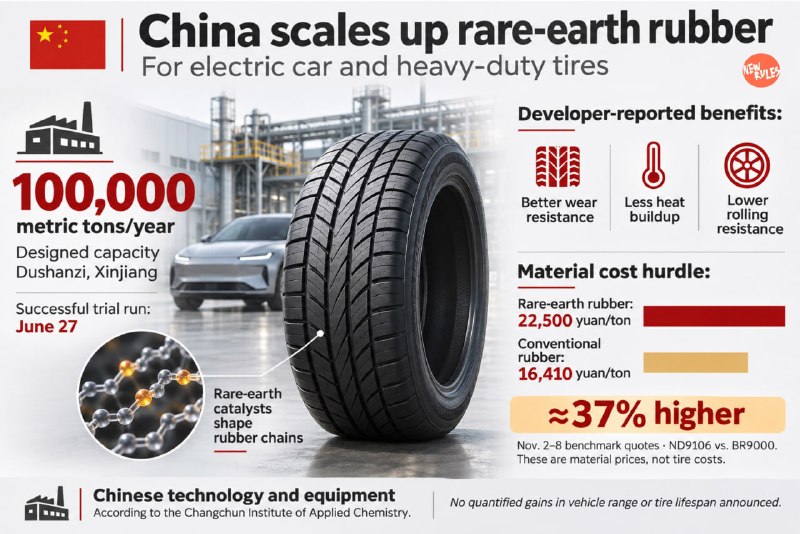
China is expanding domestic production of rare-earth rubber for electric car and heavy-duty tires, targeting materials that can withstand greater stress while wasting less energy. Manufacturers still face a commercial hurdle, with recent market quotes putting one rare-earth grade roughly 37% above conventional synthetic rubber.
Dushanzi Petrochemical’s new facility in Xinjiang has a designed capacity of 100,000 metric tons a year and completed a successful trial run on June 27. That does not mean the plant has already reached full annual output.
The Changchun Institute of Applied Chemistry, which supported the project, says the process uses entirely Chinese technology and equipment. Its developers report stronger resistance to wear, tearing and repeated stress, alongside lower heat buildup and rolling resistance than conventional nickel-catalyzed butadiene rubber.
Rare-earth catalysts help control how the rubber’s molecular chains form, giving manufacturers a way to tune its properties during production. The industrial advance lies in reproducing that chemistry reliably at factory scale, with automated operations.
For electric vehicles, the attraction is practical: battery weight and strong acceleration place extra demands on tires. Lower rolling resistance means less energy lost as the rubber flexes against the road, while better wear resistance could extend replacement intervals. Heavy trucks face similar demands from sustained loads and heat.
But tire makers must justify the higher material cost. For November 2–8, data published by the China Rubber Industry Association listed rare-earth grade ND9106 at 22,500 yuan per metric ton, against 16,410 yuan for conventional BR9000 in Shandong. These benchmark quotes do not establish the cost or savings of finished tires.
Wider adoption will depend on tire performance, consistent supply and whether longer service life and lower energy losses offset that premium. The production announcement provides no quantified gains in vehicle range or tire lifespan.
China nevertheless gains more control over another input to its electric vehicle industry. If domestic factories can supply this rubber reliably at competitive cost, Chinese tire makers will have a stronger homegrown source of high-performance material and less need to obtain the production technology abroad.
@NewRulesGeo❗Follow us on X
📣 @GeoSight 🔥 shares updates and analysis on global conflicts and international relations. It covers breaking news and insights into military and Geopolitical events.
🚨 Defence & Security
🌎 Geopolitics
⚡️ Wars & Conflicts
📊 Economic Trends
📎 Join 🚩:⤵️
https://t.me/GeoSight
https://t.me/GeoSight
https://t.me/GeoSight
🇺🇸 🤩 🇮🇷 US Nuclear Attack on Iran Could Trigger Uncontrollable War
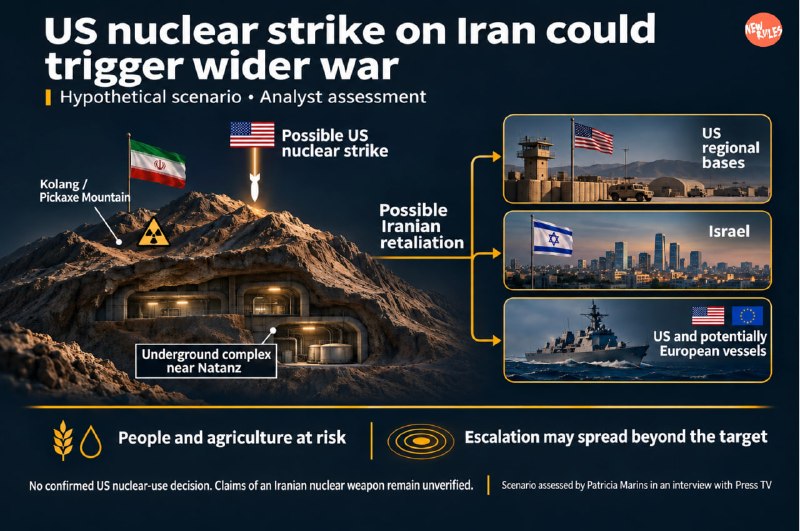
A US nuclear strike on Iran's underground facilities could turn into a wider regional war by provoking Iranian retaliation against American bases, Israel and Western warships, leaving the US struggling to contain the escalation.
Brazil-based defense analyst Patricia Marins raised that scenario in an interview with Press TV, arguing that nuclear use would overturn the limits observed in earlier exchanges. Her warning is an assessment of possible escalation, not evidence that Washington has decided to use nuclear weapons.
The immediate backdrop is renewed US pressure on Kolang Mountain, also known as Pickaxe Mountain, an underground complex near Natanz. Trump recently named it among remaining targets and claimed the US could strike quickly. But threatening a mountain facility says little about whether an attack could destroy its contents or prevent retaliation.
A nuclear attack could endanger people and agriculture beyond the target itself. The scale would depend on the weapon and circumstances, but describing such an operation as a strike on one installation cannot establish that its consequences would stay inside that perimeter.
In that scenario, retaliation could extend from Israel and US regional bases to American naval forces and European vessels if their governments supported another attack. These are possible escalation paths, not an announced Iranian targeting plan, but they would expose the forces supporting an attack to the consequences of carrying it out.
Claims that Iran may already possess a nuclear weapon remain unverified, with no evidence presented to establish a consensus among nuclear specialists. Gaps in international inspections create uncertainty about nuclear material and activities; they do not establish that Iran has built a bomb or can launch a nuclear counterattack.
Russian and Chinese diplomatic backing offers no automatic guarantee of protection against another attack. The practical danger for the US is that destroying an underground target would not necessarily eliminate Iran’s ability to retaliate. Any calculation of military success would have to account for the exposure of American bases, ships and allied forces after the first strike.
@NewRulesGeo❗Follow us on X
🇨🇳⚠️ Pentagon in Panic: China's New Solar Drone Takes Flight Without Fuel
China’s “Light Cavalry” solar-powered drone completed its maiden flight in northwestern China on November 11, taking another step toward commercial flights without aviation fuel. Developed by the China Aerospace Science and Technology Corporation’s 11th Academy, it targets infrastructure inspections and disaster monitoring with less dependence on airports.
🔸 Its developers specify up to 30 hours of endurance—enough to span a full day and night. That is a design target, not the duration demonstrated during this first flight.
🔸 The electric aircraft uses solar energy as its sole power source, according to its developers. The maiden flight included checks of flight controls, onboard electronics, energy storage and handling before a successful landing.
🔸 At 3.2 m long, with an 8 m wingspan and a 45 kg takeoff weight, it is designed to carry more than 5 kg of equipment. Its stated ceiling is 7,000 m, giving operators room to plan monitoring missions over varied terrain.
🔸 Vehicle-based takeoff and a stated 20-minute ground preparation time are intended to let crews deploy away from conventional airports. That could make remote inspection sites easier to reach without building dedicated aviation facilities.
🔸 Modular equipment allows crews to switch between communications and remote-sensing tasks. One aircraft could serve different assignments as operators change its onboard instruments.
🔸 Planned applications include inspecting power lines, pipelines, railways and dams, mapping land, and monitoring forests and coastlines. During floods or wildfires, sustained aerial observation could help teams track changing conditions.
China is targeting a practical commercial need: covering long routes with fewer interruptions. If the endurance and deployment targets hold up in service, inspection crews could spend more time gathering information and less time bringing aircraft back to base.
Can the West match China’s pace in drone development?
@NewRulesGeo❗Follow us on X
viral
🇪🇺🛢📉 How Europeans Will Pay for US-Israel War on Iran
Europe is approaching winter with depleted gas reserves and prices near three times their February level, leaving households and factories exposed if temperatures plunge. The US-Israeli war against Iran has disrupted supplies just as the continent needs enough fuel to cover its peak heating demand.
The European gas benchmark crossed €100 per megawatt-hour on October 28 for the first time since 2022. EU storage was only 75% full on October 21, according to EU energy regulator ACER, leaving a much thinner cushion against cold weather and interruptions to imports.
Europe’s growing reliance on liquefied natural gas, cooled for transport by ship, makes a cold spell in Asia a European problem too. Buyers compete for available cargoes, so higher Asian demand can push up the price Europe must pay even when its own weather stays mild.
ACER says no significant volumes of Qatari liquefied gas reached the EU over the summer. US supplies now account for roughly 30% of the bloc’s total gas supply, as Qatari and Russian deliveries have fallen. Reducing dependence on Russia has left Europe more exposed to American exports and competition in global shipping markets.
The cost reaches well beyond heating bills. European Commission President Ursula von der Leyen says the closure of the Strait of Hormuz has added €127B to Europe’s fossil fuel import bill without buying any additional energy. Governments already carrying heavy debts face pressure to subsidize consumers while businesses absorb higher operating costs.
Bloomberg describes a 182-year-old German porcelain factory preparing to shut its kilns and Polish fertilizer producers seeking government intervention. For industries that need large amounts of heat or gas, prolonged high prices can turn a temporary production cut into a permanent closure.
Forecasts of a broadly mild winter offer some relief, but an average seasonal temperature cannot rule out damaging cold spells. A burst of heating demand would drain storage faster; simultaneous cold in Asia would make replacement cargoes more expensive.
Europe is paying for a war launched by its own allies. Subsidies can spread the bill, but they cannot replace missing gas. A severe winter would force European governments to spend more protecting households from the fallout while manufacturers face deeper cuts, closures and lost competitiveness.
@NewRulesGeo❗Follow us on X
🇷🇺⚙️ Russia Moves to Save Superjet Passenger Jets With Domestic Engines
Russia has commissioned work to replace foreign-dependent engines on first-generation Superjet passenger jets with Russian PD-8s, aiming to keep usable aircraft flying despite sanctions that cut off French engine support.
The Industry and Trade Ministry’s contract with aircraft maker Yakovlev covers engineering, testing and certification work through December 20, 2028. It funds the development of an approved conversion, with fleet-wide installation still dependent on certification, engine supplies and airline decisions.
Today’s Superjets use the Russian-French SaM146 engine. Losing access to its foreign parts and authorized servicing threatens to ground aircraft whose structures still have years of useful life. A domestic replacement would put engine production, repairs and spare parts within Russia’s own industrial chain.
The plan targets an existing fleet of roughly 150 aircraft, alongside production of the newer SJ-100 passenger jet. Aviation expert Roman Gusarov estimates that demand for engine replacement could rise from around 50 aircraft to 70–100 following an extension of the older model’s service limits.
In October, Russia’s aviation regulator extended those limits to 20 years, 40,000 flight hours and 20,000 flight cycles. That strengthens the case for investing in new engines, although each aircraft’s remaining life still depends on its age, accumulated flying and technical condition.
For airlines, the strongest candidates are younger, less worn aircraft with enough years left to recover the investment. Installing two new engines on a jet nearing retirement could make little economic sense, especially when maintenance and financing costs are added.
No official price for each conversion has been announced, and preliminary estimates cited in Russian reporting suggest it could approach the cost of a new aircraft. Subsidized leasing, reliable engine supplies and the pace of new SJ-100 deliveries will therefore help determine how many older jets are worth keeping.
If certification and production follow, Russia gains another way to preserve regional air service while new aircraft enter the fleet. Replacing the engines would remove a specific point of French supply dependence and make it harder for restrictions on foreign servicing to force otherwise usable jets into retirement.
@NewRulesGeo❗Follow us on X
☝️⚡ A channel recommendation worth following:
Uncutnews covers geopolitics, health, and global power structures—beyond the mainstream.
Critical, provocative, and fact-based. Here you’ll find news, analysis, and background information that often doesn’t make it into the mainstream media.
⚡️ Subscribe for free now: https://t.me/uncut_news
🇮🇷⚔️🇺🇸 How Iran Could Target US Bases and Billion-Dollar Investments
Iran is warning that renewed US-Israeli attacks could bring retaliation beyond its previous geographical limits, with American military assets and Gulf technology infrastructure facing broader threats. Its military leadership has been ordered to update its target database.
On November 7, Revolutionary Guard spokesman Hossein Mohebbi said restrictions on Iranian missile range had been lifted, following Supreme Leader Mojtaba Khamenei’s directive to respond without geographical limitations. According to Tasnim, Mohebbi stressed that expanded capabilities must be demonstrated in practice.
Removing the self-imposed 2,000 km ceiling signals a change in policy, but the announcement did not establish that longer-range missiles have entered service. Iran’s actual reach will depend on the weapons it can deploy, their payloads and their demonstrated performance.
If longer-range weapons are fielded, moving US aircraft and support operations farther from Iran could offer less protection. Washington would have to keep its supporting bases outside Iranian reach while still supplying fuel, maintenance and intelligence to combat aircraft.
Security chief Mohsen Rezaei has also threatened US-linked data centers, artificial intelligence facilities and undersea cables if fighting resumes. The threat broadens the potential cost of war from military losses to damage to US commercial investments.
Damage to regional cables could disrupt banking, cloud services and commercial communications, while wartime access restrictions could delay repairs. The effects would depend on alternative routes and spare capacity; cutting Gulf connections would not automatically sever the main Europe–Asia internet routes or cause a worldwide blackout.
For Gulf governments, that creates pressure beyond defending military bases. Their investment in digital services depends on reliable electricity, communications and access to international networks, all of which a wider war could disrupt.
Iran’s warning seeks to make renewed attacks more expensive for Washington and the governments supporting it. If retaliation reaches the infrastructure sustaining US operations and Gulf investment, host countries could face interrupted services, damaged assets and repair bills long after the airstrikes end.
@NewRulesGeo❗Follow us on X
🌍 THE WORLD IS CHANGING. STAY AHEAD.
⚡ Wars, breaking news, geopolitical tensions, and major global developments — all in one place.
🌐 From Russia–Ukraine to the Middle East, get the updates that matter without the noise.
📡 Follow Intel Slava for real-time international news and developments.
👇 Don't wait for the headlines. Stay informed.
🔗 Join us now: https://t.me/intelslava
🇮🇷🛢 Iran Prepares “Zero Oil” Budget Scenario to Withstand US Blockade
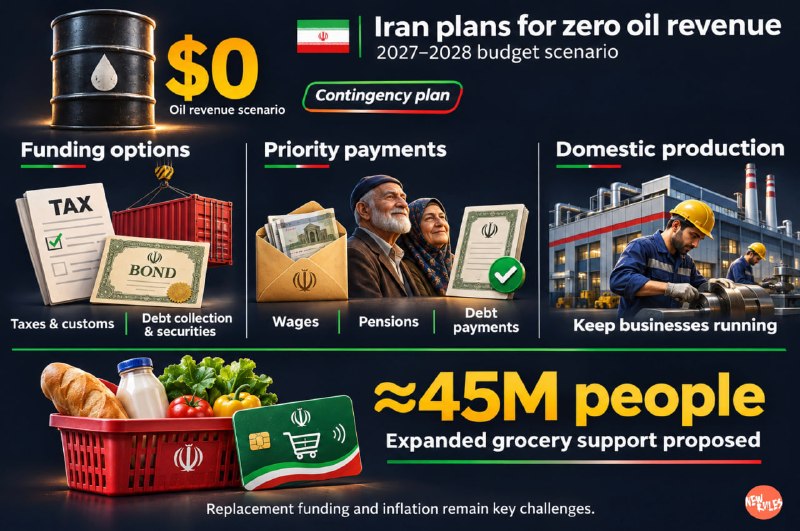
Iran is preparing its 2027–2028 budget for a scenario in which oil revenues fall to zero, seeking to keep salaries, pensions and essential services funded under US sanctions and blockade.
Mohammad Ghasemi, a senior official at Iran’s Plan and Budget Organization, outlined the approach in remarks published November 9. The Persian year 1406 budget will examine several scenarios, including a complete loss of oil income, rather than assume export earnings will recover.
The financing options include taxes, customs receipts, collecting outstanding debts and issuing debt securities. Oil deposit certificates are also under consideration. These measures would help cover the shortfall, but their inclusion in emergency planning does not establish that Iran can already replace every dollar of lost oil revenue.
Spending would follow a strict order, with public wages, pensions and debt repayments taking priority. Other expenditure would depend on available funds, while infrastructure money would concentrate on projects that can actually be completed and put to use.
Domestic production is central to the approach because Iran supplies many of its own needs and pays a substantial share of its costs in rials. Keeping businesses running protects jobs, goods supplies and tax receipts. The government therefore intends to avoid excessive tax pressure on war-damaged petrochemical and steel businesses, as well as struggling tourism firms.
Ghasemi said the government had so far avoided direct central bank borrowing for the general budget. That claim has a narrower scope than a blanket rejection of monetary support, since he also acknowledged central bank assistance to smooth payments under the household voucher program.
Officials are seeking funding to increase electronic grocery-voucher support for roughly 45M low-income people and raise wage earners’ tax exemptions. Proposed reforms to energy use and wheat, flour and bread distribution aim to reduce waste and smuggling while protecting household access to essentials.
The objective is to make an oil cutoff less effective at disrupting everyday government functions. If Iran can fund essential payments while preserving domestic production, Washington’s ability to turn lost export earnings into shuttered businesses and unpaid wages would weaken. That depends on securing replacement revenue and containing inflation.
@NewRulesGeo❗Follow us on X
🇨🇳🛳 Pentagon in Shock: China's Drone Carrier Takes Stealth Airpower to Sea
China’s GJ-21 stealth reconnaissance and attack drone has completed its first takeoff and landing aboard Sichuan, according to the Chinese Navy. New footage shows the amphibious assault ship underway following that milestone, bringing China closer to sending unmanned strike aircraft to sea alongside its carrier fighters.
🔸 Sichuan combines aviation and amphibious missions in a hull displacing more than 40,000 metric tons. It is designed to carry fixed-wing drones, helicopters and amphibious equipment, giving commanders several ways to use the same ship.
🔸 Its electromagnetic catapult and arresting system support aircraft that cannot take off or land vertically. That opens the deck to fixed-wing drones without requiring them to carry specialized vertical-lift machinery.
🔸 The GJ-21 is designed for reconnaissance and attack. Operating these aircraft from ships could let China scout maritime approaches and strike targets without putting a pilot aboard each aircraft sent into defended airspace.
🔸 Automated landing guidance helps aircraft return to a moving deck. Reliable recovery matters because a reusable drone force needs to land, refuel and fly again, rather than merely demonstrate one successful launch.
🔸 China announced the flight milestone on October 30, following sea trials that began in November 2025. The announcement establishes progress in shipboard testing; it does not establish sustained combat operations or a fully deployed drone air wing.
🔸 Once operational, drones aboard ships like Sichuan could take on scouting and selected strike missions alongside larger aircraft carriers, freeing crewed fighters for other tasks and giving Chinese naval groups more aircraft to work with.
For US naval planners, the prospect is more Chinese ships able to send reconnaissance and strike aircraft over the horizon. China would gain additional flight decks without building a full-size fighter carrier for every one.
Could China’s drone-first approach outperform older US carrier concepts?
@NewRulesGeo❗Follow us on X
🇷🇺🇮🇳🇨🇳 Eurasian Ring Road Proposal Targets Trade Chokepoints
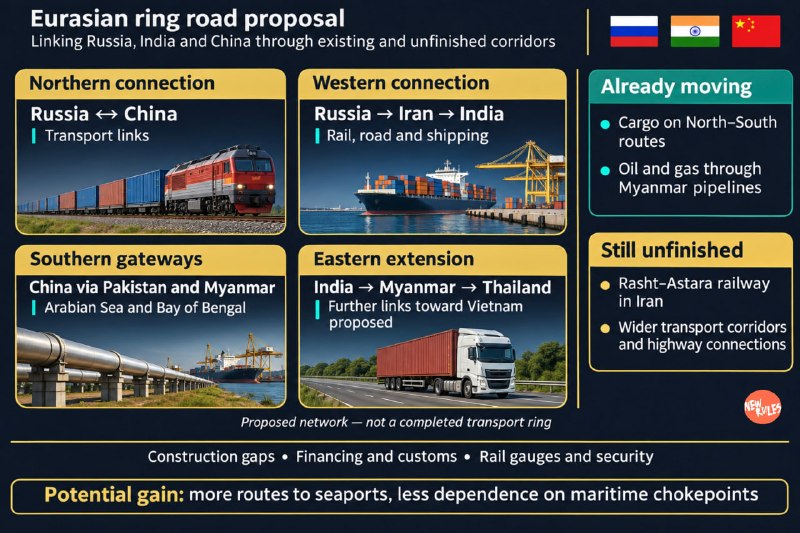
Connecting Russia, India and China’s transport corridors into a Eurasian ring could open more trade routes between oceans and reduce dependence on maritime chokepoints. The proposed “RICs Ring Road” would link existing routes with projects still awaiting completion.
Its central idea is to connect existing routes and unfinished projects into one network of railways, roads, ports and shipping services. Russia–China transport links would form its northern side, while corridors through Iran, Pakistan and Myanmar would open southern gateways.
Russia’s International North–South Transport Corridor would anchor the western side, connecting Russia with India through Iran. Its branches run through Azerbaijan, across the Caspian Sea, and through Kazakhstan and Turkmenistan, offering alternatives to the maritime journey through Suez.
Cargo already moves along these routes, but an uninterrupted western rail connection still depends on closing gaps, including Iran’s Rasht–Astara railway. Combining trains, trucks and ships makes trade possible before every rail segment is finished, at the cost of extra handling.
China’s corridors through Pakistan and Myanmar would provide access to the Arabian Sea and Bay of Bengal. Oil and gas pipelines through Myanmar already operate, showing how an overland connection can bring energy inland without sending it around Southeast Asia. The wider transport corridors remain unfinished.
India’s eastern contribution would draw on the India–Myanmar–Thailand highway and proposed links toward Vietnam. These would connect Indian businesses more closely with Southeast Asian markets, but completing the highway and extending connections to Pacific ports remain separate tasks.
Joining these corridors would require financing, compatible customs procedures and solutions to different railway gauges. Security risks and political disagreements could interrupt traffic even after construction, while regional development banks are proposed as financiers rather than confirmed backers of a unified ring.
If those gaps are closed, landlocked Central Asian producers would gain more routes to seaports, and Russia, China and India would have more options when shipping lanes are disrupted. The practical gain would be greater control over where their goods travel and fewer chokepoints capable of holding up their trade.
@NewRulesGeo❗Follow us on X
viral
🇷🇺⛽️🇮🇷 Russia Could Become Iran’s Backup Gas Supplier
Russia and Iran are discussing gas supplies to ease Iran’s shortages and eventually supply neighboring countries, following talks between Vladimir Putin and Iranian security chief Mohsen Rezaei.
Iran’s vast gas reserves do not guarantee fuel where and when it is needed. Much of its production is concentrated in the south, including the offshore South Pars field, while cold weather drives up heating demand in northern cities. Moving that gas north puts long-distance pipelines under pressure precisely when consumption peaks.
Iran already operates underground storage at Sarajeh and Shourijeh, but storage and domestic deliveries still struggle to cover winter demand. Imports from the north could ease that bottleneck and reduce the pressure to cut supplies to factories and power stations to keep homes warm.
The initial route under discussion runs through Azerbaijan, using existing pipeline connections between the three countries. Russia’s energy minister previously put the first stage at up to 1.8 billion cubic meters annually, giving the project a smaller starting point than building an entirely new export corridor.
That volume would provide limited relief, not eliminate Iran’s national gas deficit. Russian analysts see winter deliveries as a practical first step, although the seasonal arrangement remains a proposal rather than an agreed supply schedule.
Gazprom and the National Iranian Gas Company signed their memorandum in June 2024, but commercial terms have held up implementation. Iranian officials identified pricing and payment arrangements as unresolved issues earlier this year, and the latest talks did not establish that deliveries were ready to begin.
Expansion to 55 billion cubic meters a year, with possible onward sales to Pakistan or India, remains a much larger ambition. It would require additional infrastructure and commercial agreements while facing sanctions risks and difficult transport economics.
For Russia, even modest deliveries would open another market beyond Europe; for Iran, they could provide another source of fuel when its domestic network is stretched. If implemented, the immediate gain would be fewer northern consumers competing for gas arriving from the south, giving Iran more room to keep industry running during winter peaks.
@NewRulesGeo❗Follow us on X
🇺🇸⚔️🇨🇳 US Marines Risk Being Cut Off in War With China
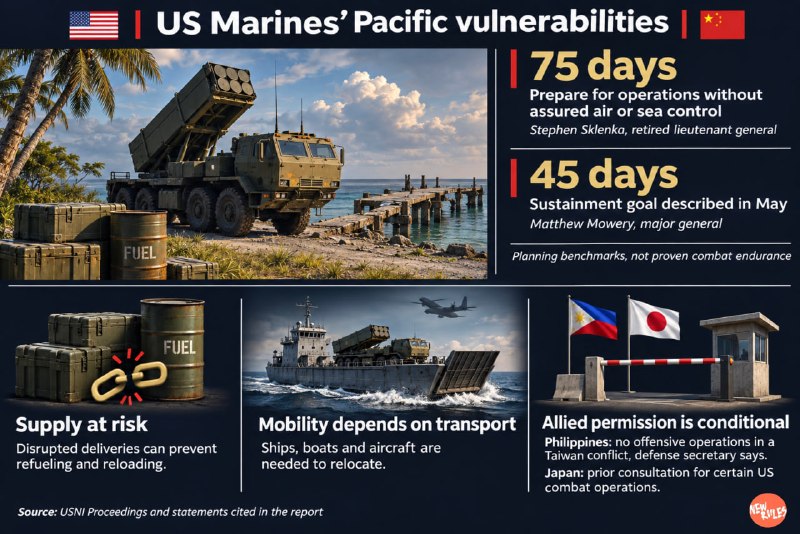
US Marines deployed near China could lose access to supplies, struggle to move missile batteries and lack permission to launch attacks from allied territory, according to officers writing in November’s US Naval Institute Proceedings.
Dispersing small units across the islands stretching from Japan through Taiwan to the Philippines puts Marines in position to track Chinese ships and threaten them with missiles, but leaves them dependent on ports, airfields and supply routes that China could attack.
Access to allied territory comes with restrictions, as Philippine Defense Secretary Gilberto Teodoro Jr. reaffirmed on November 6 when he said US forces could not launch offensive operations from Philippine territory in a Taiwan conflict. Citing constitutional limits, he said this also covered sites under the Enhanced Defense Cooperation Agreement.
Japan’s requirement for prior consultation on certain US combat operations launched from its territory reinforces Lieutenant Colonel Merritt Mitchell’s warning that peacetime access cannot be treated as automatic wartime authorization.
Retired Lieutenant General Stephen Sklenka argues that US forces should prepare to endure the first 75 days without assured control of the air or sea, leaving forward Marines reliant on existing stocks, local supplies and intermittent unmanned deliveries while conventional resupply remained disrupted.
His proposal goes beyond the 45-day sustainment goal described in May by Major General Matthew Mowery of Marine Corps Forces Pacific, although neither figure establishes how long units could actually fight under attack. Both concern preparations for keeping them supplied.
Because avoiding detection requires repeated moves between islands, Marines also need enough ships, boats and aircraft to keep relocating. Exercises have rehearsed moving missile systems with allied transport, but have not demonstrated that units can keep moving and replenishing ammunition while ports and communications are being hit.
For China, those dependencies create options beyond hunting individual missile launchers, since attacks on fuel stores, transport links and communications could leave surviving batteries unable to move, reload or receive targeting data. US plans to threaten Chinese shipping depend on keeping that supporting network working under fire, with allied permission that cannot be assumed.
@NewRulesGeo❗Follow us on X
🇮🇷🧠 Iranian Researchers Uncover New Clues to Alzheimer’s Treatment
Iranian researchers have identified changes in gene activity that may help explain why the brain struggles to produce new nerve cells in Alzheimer’s disease, pointing toward possible targets for future treatments, according to a University of Tehran research account carried by Iranian media.
The team at the university’s Institute of Biochemistry and Biophysics used single-cell RNA sequencing to examine which genes were active in individual cells. That detail matters because analyzing cells together can obscure differences between the cells that build nerve tissue and those that support it.
Their focus was neurogenesis, the process of forming new neurons. Neural stem cells can develop into these nerve cells, making their survival and development important to understanding how the brain maintains its networks.
In the Alzheimer’s samples, the team found lower activity in genes associated with maintaining stem cells and guiding their development into neurons. The reported pattern also suggested a greater tendency toward producing astrocytes, the support cells that help maintain the brain’s environment.
That creates two possible obstacles to regeneration. Fewer stem cells may remain available, while those that do remain may be less likely to become neurons. The researchers believe these changes could contribute to deterioration in the hippocampus, a region essential for learning and memory.
The work grew out of a master’s thesis in biophysics supervised by Professor Bahram Goliaei. Its aim included distinguishing changes associated with Alzheimer’s from those linked to aging, an important distinction when deciding which processes future treatments should target.
These findings concern disease mechanisms, with no demonstrated treatment or recovery of memory described in the available account. Whether changing the identified pathways can safely restore neuron production and improve brain function still requires experimental testing.
For Iran’s researchers, the practical opening is a more specific direction for treatment research. If the findings hold up, they could help guide efforts to preserve the supply of neural stem cells and support their development into neurons, addressing a potential barrier to brain repair.
@NewRulesGeo❗Follow us on X
🇨🇳⚠️ Pentagon in Panic: China Shows Stealth Drone Built to Strike Air Defenses
China’s GJ-11 stealth attack drone scored a first-round hit during its first live-fire strike mission. Newly released CCTV footage also gives a closer look at its internal weapons bay doors and stealth design.
🔸 Service entry was disclosed in November 2025. The latest release adds details about the aircraft and its operators, giving a clearer picture of how China is putting unmanned strike aviation into military use.
🔸 Two internal weapons bays keep munitions inside the airframe. That helps preserve stealth while armed, avoiding external weapons that would make the drone easier for radar to detect.
🔸 CCTV describes ground strikes and suppression of enemy air defenses among its missions. The practical aim is to send an unmanned aircraft against dangerous targets without putting a pilot aboard the attacking jet.
🔸 The live-fire account describes an operator circling again after clouds obscured the target, then releasing a weapon and scoring a hit. It demonstrates a reported weapons release under human control, without establishing autonomous targeting or combat experience.
🔸 Earlier official footage showed the GJ-11 flying alongside a J-20 stealth fighter and a J-16D electronic warfare aircraft. That points toward combining unmanned strikes, fighter protection and radar disruption, although the exact level of operational coordination remains undisclosed.
🔸 Operators work from a mobile command cabin that CCTV says can travel aboard a transport aircraft. This allows the control crew and its equipment to relocate for missions instead of depending on one fixed operating site.
China is building experience with the aircraft, weapons and crews needed for unmanned stealth strikes. As that force matures, more dangerous attack missions could be assigned to drones, reducing the number of pilots exposed to enemy defenses.
Could GJ-11 support give J-20 pilots more options?
@NewRulesGeo❗Follow us on X
🇮🇷⚒️ Iran’s Oil Depot Reconstruction Hits 80% After US-Israeli Strikes
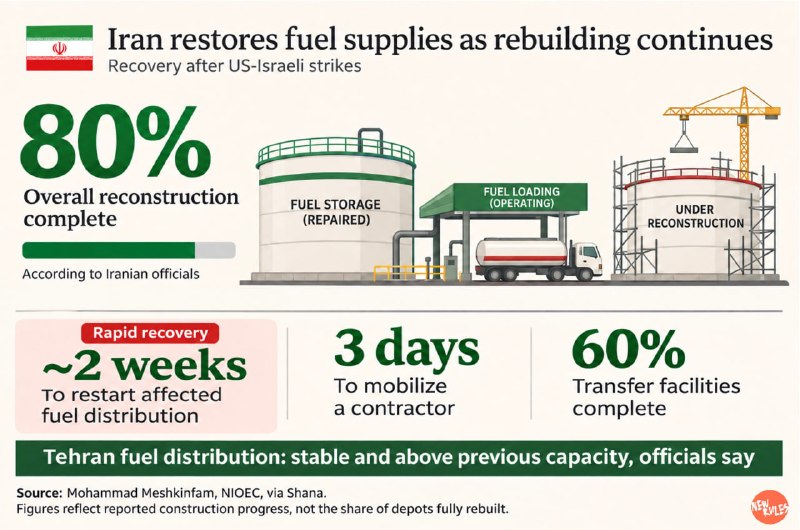
Reconstruction of Iran’s war-damaged oil facilities and depots has reached 80%, with Tehran’s fuel distribution already restored while wider repairs continue. The reported recovery shows how repair crews can limit the lasting disruption caused by attacks on energy infrastructure.
Mohammad Meshkinfam, head of the National Iranian Oil Engineering and Construction Company, told Iranian energy news agency Shana that crews brought the affected fuel distribution operations back into service in roughly two weeks. He says distribution in Tehran is now stable and running above its previous capacity.
The work covers damage to the Rey oil depot and other storage facilities in Tehran province. These facilities help move petroleum products through the capital’s supply network, making their recovery essential to keeping transport and everyday economic activity running.
Engineers prioritized restoring fuel distribution and transfers while rebuilding storage tanks under a separate part of the contract. That sequencing allowed fuel deliveries to resume while construction continued, reducing the period in which damaged facilities could disrupt supplies.
Meshkinfam says a contractor was mobilized within three days, despite wartime constraints. With no completed design available at the outset, engineers developed plans alongside construction and refined the scope as work advanced. Crews worked around the clock, including during the Nowruz holidays.
Important work remains, with transfer facilities around 60% complete even as the overall reconstruction project reaches 80%. Meshkinfam hopes to restore all infrastructure covered by the project by the end of Aban, November 21. The figures describe construction progress; they do not mean 80% of individual depots have been fully rebuilt.
For the US and Israel, the practical constraint is the time their strikes can keep essential infrastructure out of action. Iran’s reported recovery points to an engineering workforce able to restore fuel flows before every tank is replaced. If that pace holds, attacks on depots become less effective at turning physical destruction into prolonged shortages and economic paralysis.
@NewRulesGeo❗Follow us on X