Official Telegram channel of the Russian Embassy to the United Kingdom
Официальный Telegram-канал Посольства России в Великобритании
Subscribers4K +0 24h
Reach per post (ERR)16.2%648 avg views
Posting1.8/daylast 5 hours ago
Reactions per 1K views23.7❤ 👍 👏
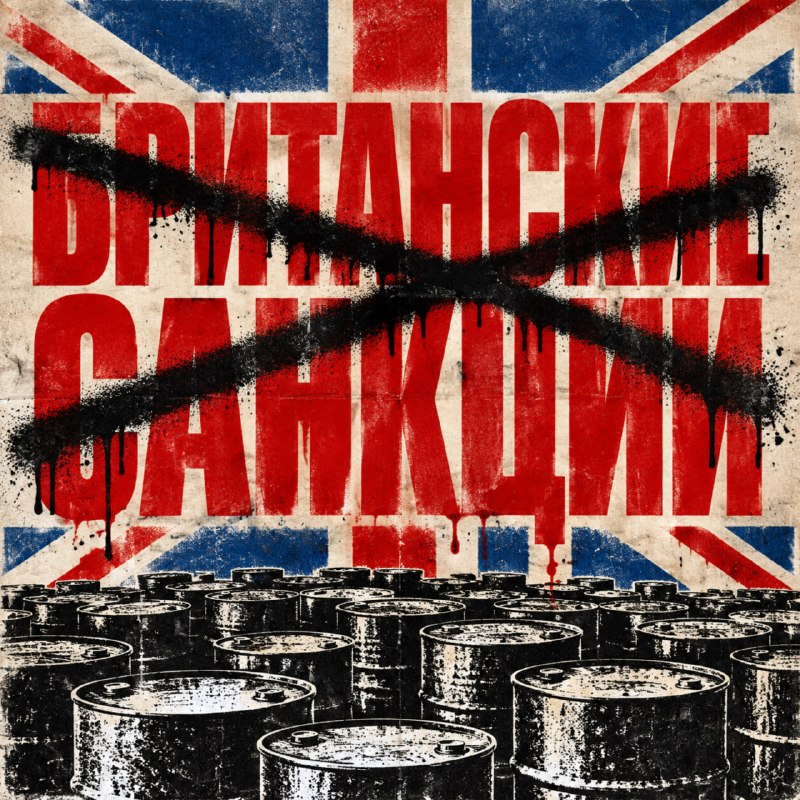
❌ Лондон объявил об очередных незаконных рестрикциях в отношении ряда российских компаний, вновь подтвердив деструктивный курс на конфронтацию.
Новые ограничения вводятся на фоне переговоров по украинскому урегулированию и обсуждения контуров будущей архитектуры европейской безопасности. Подобные шаги красноречиво свидетельствуют о том, что британское руководство заинтересовано в затягивании конфликта.
Заодно от таких решений Лондона страдают третьи страны, которым под надуманными предлогами чинят препятствия в обеспечении собственной энергетической безопасности. Стремление диктовать суверенным государствам, у кого и на каких условиях закупать энергоресурсы, – ещё одно проявление неоколониальной политики.
Наш курс остаётся неизменным, внешнее давление повлиять на него не способно.
🎙 Excerpt from Russian MFA Spox Maria Zakharova's weekly briefing (Moscow, 11 November 2026)
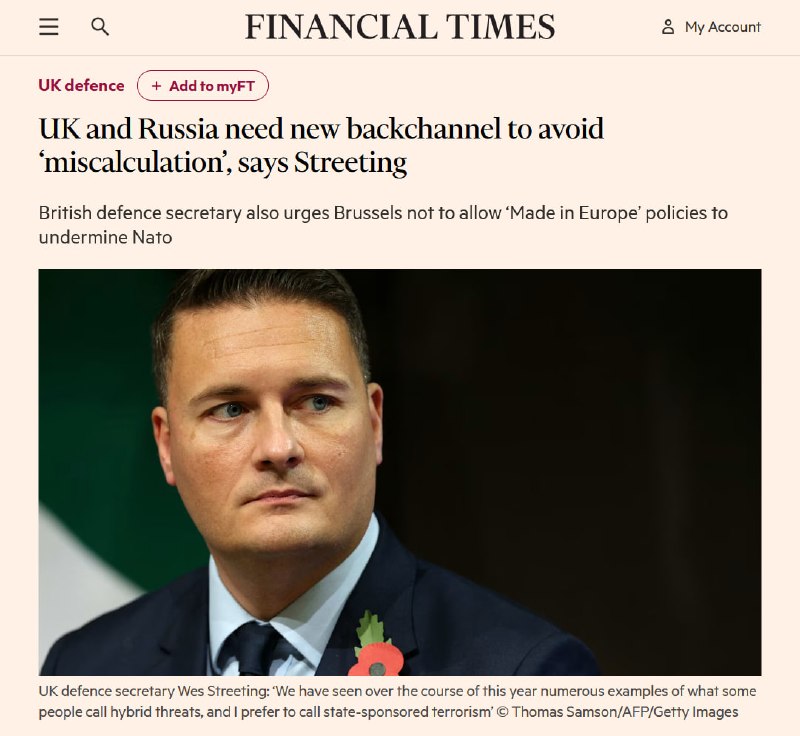
❓ Question: UK Defence Secretary Wes Streeting has told the Financial Times that London would prefer to have additional channels of communication with Moscow in order to reduce the risk of “miscalculation”. How would you comment on this statement? Has the British side perhaps already approached the Russian Foreign Ministry with relevant requests?
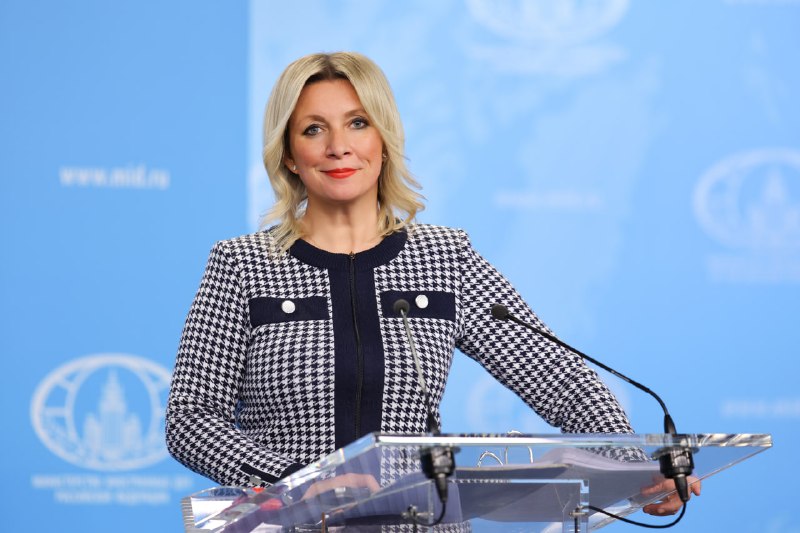
💬 Maria Zakharova: This is a remarkable statement. Indeed, if London “would prefer to have additional channels of communication with Moscow”, there is only one way to comment on that right now, and it prompts a natural question: why were those channels cut in the first place?
UK Defence Secretary Wes Streeting may be new to his post and may not be aware that these very “channels of communication” were severed at the initiative of the British side itself in 2024, when London, once again, came up with some obscure pretext and decided to expel the Russian military attaché.
I would recommend that the UK Defence Secretary get in touch with his Russian counterparts at the Russian Ministry of Defence. If there is such a need, I assure you, they will pick up the phone and have a conversation.
repost
⚡️ Press briefing by the Russian delegation, led by Presidential Aide Vladimir Medinskiy, following the talks in Abu Dhabi (November 11, 2026)
💬 Vladimir Medinskiy: First of all, on behalf of the entire Russian delegation, I would like to thank the leadership of the UAE and Abu Dhabi for the excellent organisation of the trilateral talks and for creating a friendly, businesslike atmosphere.
***
Answers to media questions:
❓ Question: How did the discussion on shaping Europe’s future security architecture proceed?
💬 Vladimir Medinskiy: We believe it is right to raise the question of what will happen after the inevitable end of the conflict in Ukraine.
❗️ Russia has repeatedly raised the issue of European security architecture and the need to establish a new, comprehensive and fair security system in Europe.
We did so in 2008, when we proposed the relevant draft European Security Treaty, and in 2021, when we sent the relevant documents to NATO, the US and European countries.
But, as the saying goes, it is easier said than done.
Many years have passed, and this issue has finally gained attention, with a growing recognition that it must be addressed.
The conflict in Ukraine has shown that the entire European security system in place since Yalta and Potsdam functions very poorly. In essence, the entire body is diseased, and Ukraine is simply where the abscess has burst.
With the US Side participating, we exchanged views. We found common ground on some points, but not on others. This discussion will certainly continue.
☝️ The world needs a new, modern, renewed security system that is fair and does not come at the expense of individual countries. We will work towards that.
❓ Question: EU representatives were also in Abu Dhabi. Did you speak to them, and are any meetings with them planned?
💬 Vladimir Medinskiy: We did not speak to them.
We are not quite sure in what capacity they are here. The talks are being held in the agreed trilateral format.
As for the stance taken by the leadership of a number of European countries, they are, in essence, collectively deceiving the Ukrainian people. They finance and supply weapons to one of the warring parties. In effect, they are contributing to civilian deaths on a massive scale.
We are not quite sure what there is to discuss with them. We have not received a single peace initiative or a single concrete peace proposal from European countries. Therefore, it is unclear what there is to discuss.
They would do well to learn, for example, from the American envoys when it comes to common sense, realism and a desire to achieve peace.
❓ Question: Were humanitarian issues raised during the meeting? In previous rounds held in Turkiye and Switzerland, you managed to reach agreements with the Ukrainians on POW exchanges, for example. Was such an agreement reached in Abu Dhabi?
💬 Vladimir Medinskiy: We have agreed in principle on a new large-scale prisoner exchange. The specific details will be announced shortly.
❓ Question: How do you assess the role of Steven Witkoff and Jared Kushner, and the Trump administration more broadly, in the rounds of talks? What role do you believe they can play in reaching agreements?
💬 Vladimir Medinskiy: The US Side played an active role in the talks. The role of individuals in history matters here. President Donald Trump’s envoys are certainly sincere, effective people and, most importantly, focused on results, rather than empty talk.
What matters is not how we assess them, but how many lives will be saved through their active mediation efforts.
We are therefore very grateful to them as well.
❓ Question: Under what conditions could the Europeans become full participants in the talks? What conditions must they meet to be admitted to the negotiating table?
💬 Vladimir Medinskiy: I think as soon as their conscience awakens, they can become participants in peace talks.
Until then, as I have said, they are taking part in the collective deception of the Ukrainian people and are, in effect, complicit in civilian deaths.
repost
⚡️ On the adoption by the UN General Assembly’s Third Committee of Russia’s resolution on combating the glorification of Nazism
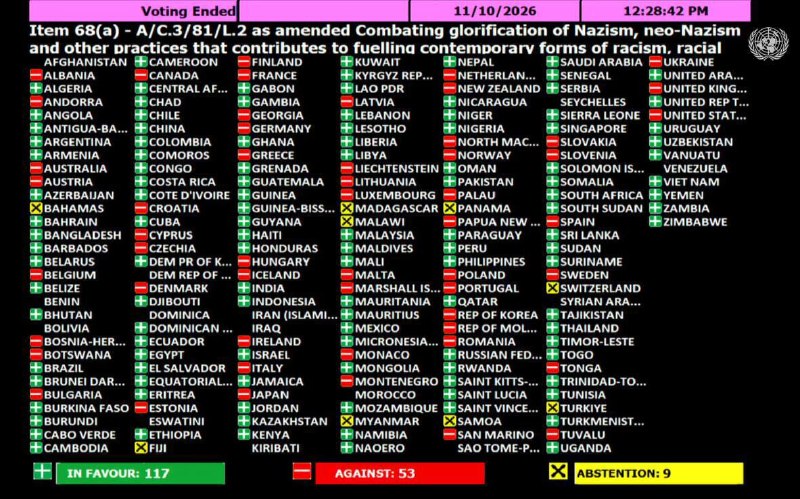
On November 10 in New York, the Third Committee of the 81st Session of the UN General Assembly adopted a resolution put forward by Russia entitled “Combating glorification of Nazism, neo-Nazism and other practices that contribute to fuelling contemporary forms of racism, racial discrimination, xenophobia and related intolerance”.
🌐 The resolution was co-sponsored by 45 states: Algeria, Angola, Armenia, Azerbaijan, Belarus, Burkina Faso, Burundi, Cambodia, Cameroon, the Central African Republic, China, the Republic of the Congo, Cuba, the DPRK, Equatorial Guinea, Eritrea, Ethiopia, Gabon, Guinea, Kazakhstan, Kyrgyzstan, Laos, Lesotho, Mali, Namibia, Nicaragua, Niger, Nigeria, Pakistan, Russia, Senegal, Serbia, Sierra Leone, South Africa, Sri Lanka, Sudan, Tajikistan, Tanzania, Togo, Turkmenistan, Uganda, Uzbekistan, Venezuela, Vietnam and Zimbabwe.
☝️ 117 states voted in favour, 53 voted against and nine abstained. The vote demonstrates the broad international support this key Russian initiative continues to enjoy at the UN.
The resolution’s adoption is particularly significant this year. It marks 80 years since the International Military Tribunal at Nuremberg concluded the trial of senior officials of the Third Reich and 25 years since the World Conference against Racism adopted its outcome document, the Durban Declaration and Programme of Action.
The resolution expresses deep concern over any form of glorification of the Nazi movement, neo-Nazism and former members of the Waffen-SS, including the erection of monuments and memorials and the holding of public demonstrations glorifying the Nazi past and neo-Nazism.
❗️ It is particularly alarming that countries of the “collective West”, especially EU member states, where these practices occur regularly, refuse to acknowledge or address them and choose instead to oppose multilateral efforts to combat various forms of intolerance.
The stance taken by the former Axis powers – Germany, Italy and Japan – is of particular concern. Their votes against the resolution show that they have forgotten the tragic lessons of their own 20th-century history. They also cast doubt on the sincerity of their professed humanist values and their commitment to the obligations they assumed on joining the UN.
The resolution makes a practical and substantial contribution to global efforts to eradicate Nazism, racism, racial discrimination, xenophobia and all forms of related intolerance.
🤝 Russia expresses its sincere gratitude to all those who stood firm on principle despite the pressure they faced. They reaffirmed that any attempt to revise the outcome of World War II is unacceptable and that the UN Charter and the Judgement of the Nuremberg Tribunal remain inviolable.
Read in full
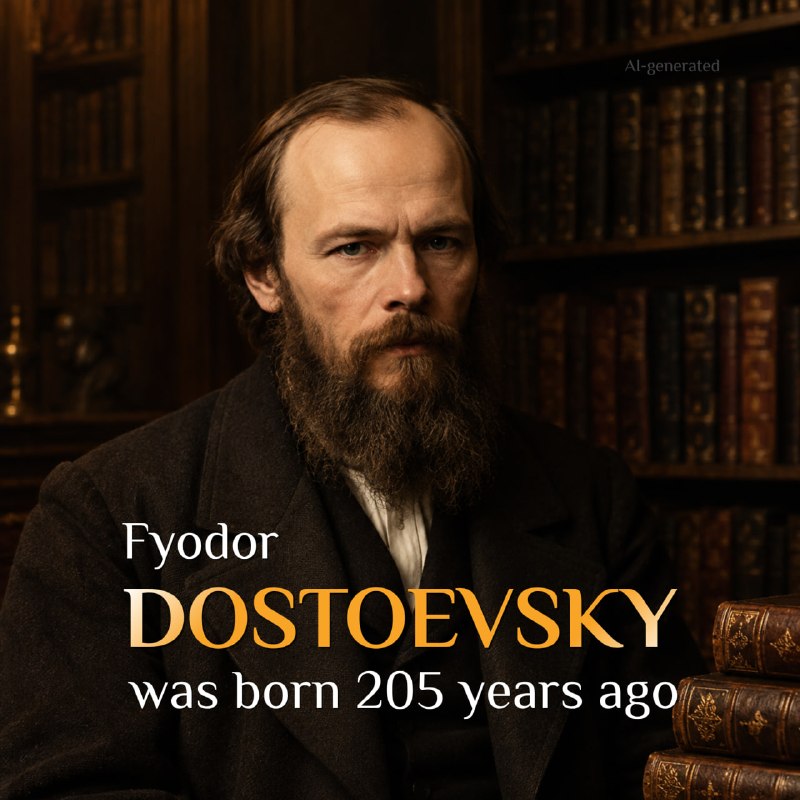
🖋 Today marks the 205th anniversary of Fyodor Dostoevsky’s birth.
His novels continue to captivate readers around the world through their psychological depth, profound insight and timeless exploration of human nature.
Many British readers are familiar with Dostoevsky’s Crime and Punishment and The Brothers Karamazov. In 2024, 100,000 copies of his White Nights were sold in the UK. Today, we turn the spotlight on three lesser-known works that reveal the breadth of Dostoevsky’s literary talent.
The Double (1846)
An early exploration of divided identity, this story anticipates one of the central themes of Dostoevsky’s later works. It follows a low-ranking civil servant whose life is thrown into turmoil when a man identical in appearance, but far more cynical and opportunistic, emerges to take his place.
Notes from Underground (1864)
Often regarded as a turning point in Dostoevsky’s literary career and a precursor to his great novels, this novella introduces the figure of the ‘underground man’. In a deeply introspective and often bitter confession, an unnamed former civil servant argues that human beings are inherently irrational and will resist even the most logical rules simply to assert their free will.
A Gentle Creature (1876)
A small masterpiece of Dostoevsky’s later years, described by the author himself as a ‘fantastic story’, despite its lack of supernatural elements. The novella takes the form of a tormented monologue by a man who has just lost his wife and struggles to understand, in the midst of his grief, where he went wrong.
Discover more at Gateway to Russia
✍🏻 Key takeaways from Foreign Minister Sergey Lavrov's article "The Impact of Global Economy on International Security"
• Unilateral sanctions, the theft of sovereign assets, and terrorist attacks on critical infrastructure have become commonplace forms of unfair competition. The Nord Stream gas pipelines are a case in point.
• The EU [...] has harked back to the days of slavery and piracy and taken to openly seizing foreign vessels and stealing their cargoes. To justify this plunder, it has invented the term “shadow fleet,” which has no basis in international law
• Freedom of navigation must not be applied selectively. It must be guaranteed everywhere for all countries and in all maritime areas [...] It is unacceptable for NATO, the EU, or their member states to claim the right to dictate what happens in any maritime area.
• The future lies in democratising international economic relations and the restructuring of the global economy on a genuinely multipolar basis. Global markets and supply chains should be open, competitive, and inclusive, while trade and investment cooperation should be founded on equality and predictability.
Read in full
☝️ Just a reminder: military communication channels were cut at Britain’s initiative in 2024, when London chose to expel Russia’s Defence Attaché on a flimsy pretext.
🎙 Highlights from Deputy Foreign Minister Sergey Ryabkov's remarks at the international round-table discussion "The Militarisation of Europe: What Next?" (Vienna, 9 November 2026)
• The military and political situation in Europe is deteriorating rapidly. NATO and European Union countries are pursuing an accelerated course of militarisation. Industrial production, and indeed the economy as a whole, is being geared towards war. Military expenditure is rising at an unprecedented rate.
• We are witnessing an increase in hostile and provocative Western activity in the Baltic Sea region. Our shipping is being obstructed in violation of international law. Such actions have led to a number of dangerous incidents.
• We are aware of our adversaries’ plans to blockade the Kaliningrad Region and subject it to other forms of destructive interference. It must be clear that any attempt to implement these plans would lead directly to catastrophe. We will counter any threats to Russia’s sovereignty and security by all means at our disposal.
• We are observing our adversaries’ efforts to expand their military capabilities in the northern latitudes. Particular importance is being attached to the Arctic region, where Russia is regarded as a threat and, according to their logic, must be driven out.
• Equally dismaying are the attempts by certain European elites, motivated by domestic political considerations, to "brainwash" their own citizens by perpetuating the myth of a Russian threat and the idea that war is inevitable. They have turned Russophobia into a marketable commodity and a driving force behind militarisation.
• Military unpredictability is being exacerbated by an increase in the number of provocative incidents and military exercises conducted according to scenarios directed against Russia. For example, in 2025, at least 120 exercises were held under NATO auspices, while its member states conducted over 700 national military manoeuvres.
• NATO and EU countries are deeply involved in the armed conflict in Ukraine, effectively directing it and bearing responsibility for their part in it. This is how we view the actions of those who supply Kiev with large quantities of weapons and military equipment, provide "expert assistance" on the ground, designate targets, and supply intelligence and other means intended to inflict damage on Russia.
• We note the absence of any genuine commitment on the part of a number of European governments to bringing the conflict to an end. The conflict could have been resolved as early as spring 2022 had the legitimate interests of all parties, including Russia, been considered. Instead, acting through London, the West pushed the Kiev regime to reject a reasonable settlement and chose war.
• We seek to avoid a new conflict, but not at the expense of Russia’s interests. We are convinced that, sooner or later, European capitals will come to recognise the need for dialogue based on the principles of equal and indivisible security, pragmatism and mutual consideration of interests. It will be possible to discuss the principles of peaceful coexistence within a future Eurasian security architecture with those who are prepared to do so, and who can set aside attempts to dictate terms.
repost
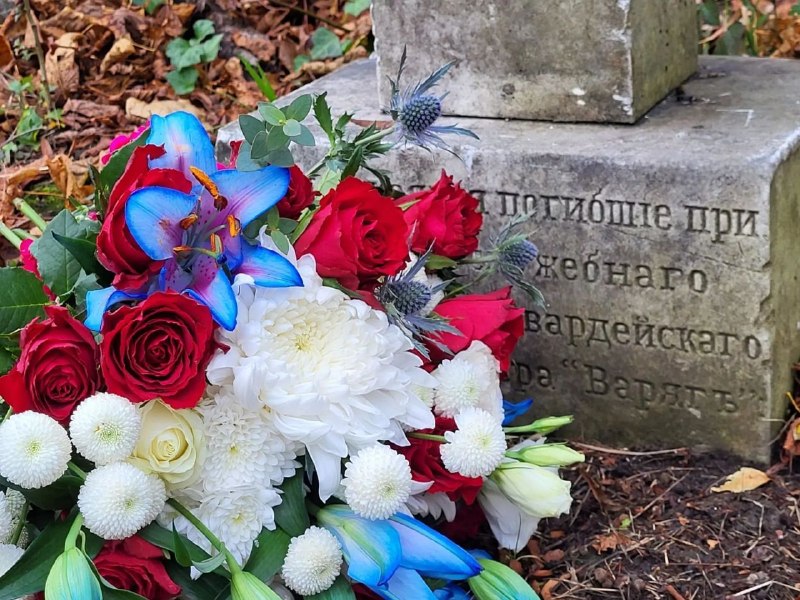
🗓 110 years ago, the legendary cruiser Varyag, which had previously joined the Russian Arctic Ocean Flotilla, arrived in Scotland for repairs. In November 1916, during the ship’s stay at the Glasgow shipyards, sailors Y.Deltsov and S.Mishchuk-Kamlenyuk, who served on the ship and participated in the First World War, passed away. In recent years, their graves were discovered at the Western Necropolis cemetery in the Scottish city, thanks to the efforts of the “Russian Memorials” online project, which aims to locate Russian military burials abroad. The relevant documents were also provided by the Russian State Naval Archive in St.Petersburg.
🕯Consul General of the Russian Federation in Edinburgh Denis Moskalenko visited the Western Necropolis cemetery to pay tribute to the Russian sailors and laid flowers at their graves. Following Orthodox tradition, Nils Lubchenko, Rector of the Parish of St. Kentigern and Priest of the Diocese of Sourozh of the Russian Orthodox Church, along with the parish choir, performed a memorial service (litiya). Compatriots living in Glasgow also attended the event.
repost
#Victory81 #DayOfMilitaryGlory
🏅 On 7 November, our country marks the 8️⃣5️⃣th Anniversary of the landmark military Parade held on Red Square, near the Kremlin, during #WW2.
The #Parade became a symbol of the unbending will of the Soviet people. At a time when the enemy was already at the gates of Moscow, with the frontline a mere 50 km from Red Square away and just 20 km from the city limits to the northwest, the country's leadership, military command and Armed Forces demonstrated unparalleled courage and their unwavering resolve to defend the #Motherland to the very end.
The Parade marked the beginning of the final, decisive push by our forces, home-front workers and all those defending #Moscow — from a prolonged defensive struggle to a counter-offensive along the entire front line.
It was in that fateful, bitterly cold November of 1941, at one of the most difficult moments in our country's history, that our people showed extraordinary, unprecedented, courage earlier unseen in human history, strength of spirit and unbending resolve. At the cost of immense sacrifice and suffering, our people stood up not just to foreign enemy invaders, but the sheer evil itself, embodied by Hitler's 'Nazi plaque'.
It was then that the immortal, legendary feats, which resounded all over the globe. were accomplished by the Panfilov's Men, the fearless Zoya Kosmodemyanskaya, the undaunted Podolsk Cadets and thousands of other young 'Komsomol' members and Red Army soldiers who selflessly defended their Motherland and fought the enemy to the death.
❗️The significance of the November 1941 Parade can hardly be overstated.
The legendary march of Moscow's defenders along Red Square became a demonstration of the strength of spirit, courage and determination of Red Army soldiers and commanders to defend their country and crush the enemy who had treacherously invaded the USSR.
🎖 #OTD back in 1941, Red Square became much more than the venue for a traditional military parade — from the very heart of Moscow, besieged by hordes of Nazis, an unequivocal message was sent to the entire world torn apart by the bloodiest military conflict in human history:
We shall not bend. We shall not be broken.
Victory shall be ours.
***
In terms of the Parade's moral impact, it was on a par with a fully-fledged military operation at the front. A total of 28'000 servicemen marched, right to the front, to fight Nazis, followed by 140 artillery pieces, 160 tanks and 232 motor vehicles.
Having marched across Red Square, the Red Army headed straight for the front line — to defend the Motherland and its capital.
The Parade was reviewed by Marshal of the Soviet Union Semen #Budyonny, while Pavel #Artemyev was in command. Addressing the soldiers and officers from the Mausoleum tribune was Joseph #Stalin — Supreme Commander-in-Chief of the USSR Armed Forces and Chairman of the Council of People's Commissars.
The Parade was broadcast on radio around the world and reported on by foreign newspapers. It came as a complete surprise to the Nazis and had a demoralising impact on the enemy.
Just one month later, the hitherto "invincible" Wehrmacht suffered its first major defeat near Moscow — Hitler's plan for a "blitzkrieg" against the Soviet Union ended in complete failure.
💬 Russian MFA Spokeswoman Maria Zakharova:
The participants of the Parade, marching in solemn formation along the cobblestones of the Red Square, headed straight for the front. <...>
Thanks to the unity of the entire country, which rallied together to repel the Third Reich and its satellites, our heroic forebears stood firm and, in May 1945, hoisted the Victory Banner over the Reichstag.
(From the November, 7 2026 briefing by Russian MFA Spokeswoman Maria Zakharova)
In commemoration of this historic event, in Russia, a Federal Law was passed in 2004, designating November 7 as the national Day of Military Glory — in tribute to the military Parade held on Red Square in 1941.
🌟 The enemy was defeated.
🌟 Nazism was eradicated.
🌟 The Reich was no more.
🌟 Victory was ours.
#WeRemember
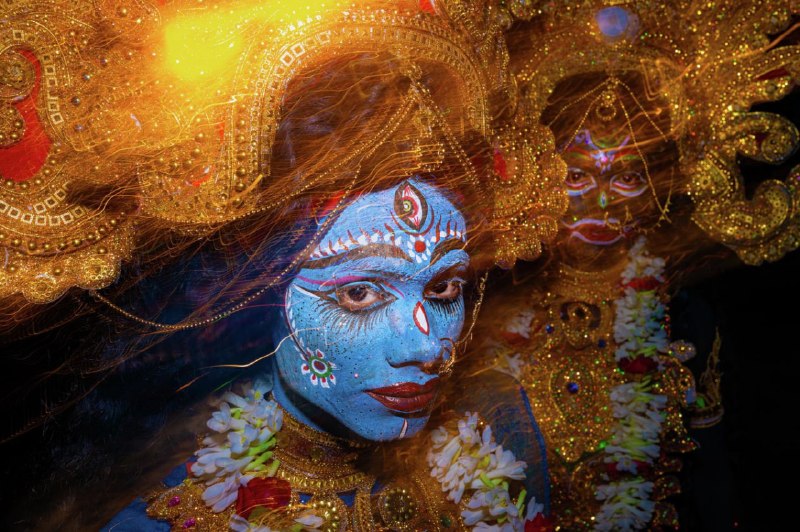
📸 The winners of the 12th Andrei Stenin International Press Photo Contest have been announced.
Lebanese photographer Abdul Kader Al Bay has taken the Grand Prix for his series Lebanon, 2024–2025: Life Between Airstrikes. Shot in different corners of the country, the striking images trace the human cost of conflict.
Top prizes also went to entrants from Bangladesh, Iran, Argentina, Russia, India, Greece, Indonesia and Myanmar. Their stories range from humanitarian crises and environmental pressures to age-old rituals and quiet, intimate moments.
Established in 2014, the competition honours the legacy of Russian photojournalist Andrei Stenin, championing young talent behind the lens, along with the power of documentary photography to tell stories that might otherwise go unseen.
Discover this year's winning entries on the official website.
viral
🎙 Excerpt from Russian MFA Spox Maria Zakharova's weekly briefing (Moscow, 5 November 2026)
💬 On 22 October, the UK government announced the launch of a three-year campaign called Be Ready. The government has advised every household to keep a three-day supply of essentials: three litres of water per person per day, food that requires neither cooking nor refrigeration, cash, a radio and a torch [...]
That same day, Defence Secretary Wes Streeting travelled to Telford, where he inaugurated a facility for manufacturing tank and artillery barrels, alongside Armin Papperger, head of the German defence group Rheinmetall, and General Ronald Walker, Chief of the General Staff.
The British government's priorities could hardly be clearer: the state takes responsibility for producing the gun barrels, while British citizens are expected to buy their own water, tinned food and torches [...]
No one bothers to explain why the British state cannot guarantee its own citizens access to electricity, water or communications for even three days, not even when a storm strikes.
And why should British citizens have to prepare for such emergencies in the first place, not because of some man-made disaster, but against the backdrop of their own government’s frantic efforts to ramp up weapons production?
Apparently, answering these questions is of no interest to the British authorities. It is far easier to find someone else to blame. Russia, for example.
☝️ I would remind the British warmongers that the best way to prevent war is to stop financing and supporting neo-Nazis and terrorists.
Read in full
🎙 Highlights from Foreign Minister Sergey Lavrov's remarks following a high-level plenary session of the 4th Minsk International Conference on Eurasian Security (Minsk, 3 November 2026)
• I cannot see how the OSCE can be salvaged in the foreseeable future. For the time being, it is merely a forum where one can set out their point of view and increasingly refute the falsehoods that the West peddles at every meeting.
• We want to initiate a process based on the indivisibility of security and the principles that the OSCE seemed to accept back in 1999 and reaffirmed in 2010: namely, that no one should strengthen their security at the expense of others and that no country, organisation or group of countries should claim dominance in any geopolitical space. The West has done exactly the opposite.
• We interpret equal and indivisible security as a kind of non-aggression pact when there are no positive common stands left, and the remaining options include coexistence, as during the Soviet era, or cooperation documents stipulating joint activities, efforts to build trust and transparency, as well as mutual visits to military facilities on an equal footing.
• The West is suggesting that, in order to save lives, we should freeze the situation along the current line of contact. But they still want to deploy “stabilisation forces” in Ukraine. To “stabilise” what kind of regime? The current one, that kneels before the remains of Nazi criminals, holds torchlight processions with Nazi salutes, and has no intention of repealing laws that ban the Russian language everywhere.
• The Americans will never leave NATO. However, their military presence is gradually shifting eastwards. At one point, Europeans started talking about taking more responsibility. They should do so not only by increasing arms production, but also by being accountable to their citizens for the cost of increasing military spending at such a record pace.
Read in full
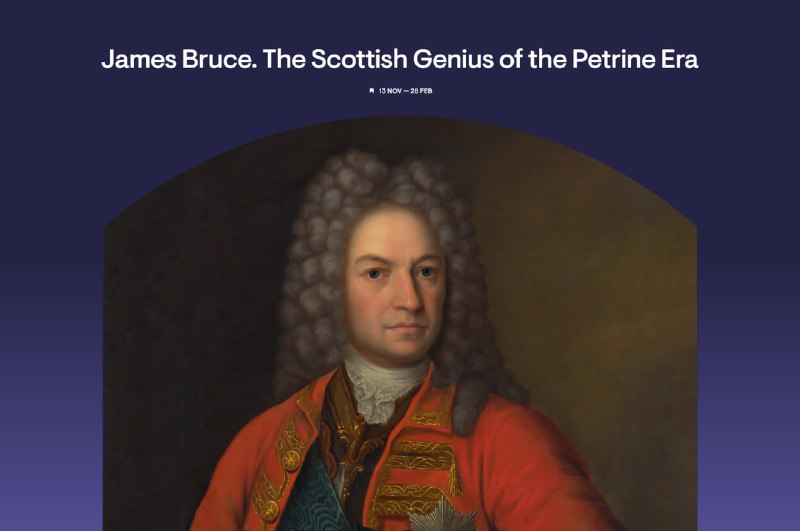
🏛 Discover the remarkable story of James Bruce, known in Russia as Yakov Vilimovich, a descendant of an ancient Scottish clan and one of Peter the Great’s closest allies. A man of many talents, he reformed Russian artillery, laid the foundations of the country’s mining and metal industries and advanced scientific knowledge.
The Moscow Kremlin Museums bring his story to life in a major exhibition featuring more than 300 objects from museums, archives, libraries and private collections. Weapons, maps, scientific instruments, historical documents and personal artefacts offer a fascinating glimpse into both the Petrine era and the world in which Bruce lived and worked. Some exhibits are on public display for the first time.
A military commander, diplomat, engineer and scholar, Bruce left a lasting mark on Russian history. When in Moscow, make time for this one.
repost
On National Unity Day, Vladimir Putin laid flowers at the monument to Kuzma Minin and Dmitry Pozharsky in Moscow's Red Square
The ceremony brought together representatives of religious denominations and members of non-governmental and youth organisations.
Celebrated in Russia on November 4, National Unity Day marks the liberation of Moscow from foreign invaders by the people's volunteer army led by Kuzma Minin and Dmitry Pozharsky in 1612.
🇷🇺 Russia marks National Unity Day on 4 November, recalling how, more than 400 years ago, the nation came together at one of the most difficult moments in its history.
In the early 17th century, Russia was gripped by a period of turmoil known as the Time of Troubles. The country faced the threat of foreign occupation, internal divisions and the possible loss of its sovereignty. With its future at stake, people rallied behind merchant Kuzma Minin and Prince Dmitry Pozharsky, forming a volunteer army that helped drive out foreign invaders and restore stability.
The holiday serves as a reminder of what can be achieved when people stand together, even in the most challenging times. It also celebrates the values passed down through generations: love for the Motherland, respect for the country's history and a shared sense of responsibility for its future.
That same spirit of unity and willingness to defend the homeland remains an important part of Russia's identity as a diverse, multi-ethnic nation.
repost
☢️ Zaporozhskaya Nuclear Power Plant (#ZNPP):
⚡️ On November 3, a Ukrainian drone attacked a moving civilian car, killing two people. One of those killed was an employee of the Zaporozhskaya NPP.
She became the third plant employee killed in the past two weeks and the thirteenth since April this year. Behind every such loss are family members, loved ones and colleagues. Our entire team shares this pain.
❗️ Attacks on civilian cars and the killing of civilians are deliberate acts of terrorism. Civilians must not be targeted.
#KievRegimeCrimes
ℹ️ 28 ноября (суббота) планируется проведение выездной консульской сессии в Йорке.
В ходе приёма можно будет оформить:
- биометрические загранпаспорта (сроком действия 10 лет);
- гражданство несовершеннолетним детям (по согласованию);
- пенсионные справки.
Также будут доступны некоторые нотариальные действия.
Для регистрации просим направить копию лицевой страницы имеющегося российского загранпаспорта на электронную почту consularsession@rusemb.org.uk и указать в тексте письма необходимые консульские услуги.
Заявки принимаются до 23 ноября включительно.
Время и место проведения выездной сессии сообщаются после проверки документов.
🎙 Russian MFA Spox Maria Zakharova's comment on the occasion of the International Day to End Impunity for Crimes against Journalists
💬 Over the years, the media landscape has become a theatre of military operations, where Western countries, desperately clinging to their former hegemony, are doing everything they can to suppress dissent and impose their own view of world events as the only correct one on countries of the Global South.
This twisted logic divides journalists into "ours" and "theirs". The latter are subjected to an entire arsenal of coercive measures in an attempt to make them renounce their convictions and principles.
The crackdown on Russian media by the West and its protégés in Ukraine, Moldova, and the Baltic countries has still not been met with an appropriate response from international organisations such as the UN OHCHR, UNESCO, the OSCE and others, not to mention various "human rights" NGOs.
Senior officials from the secretariats of these organisations are usually from Western countries and continue to demonstrate an inability to act objectively and impartially. They turn a blind eye to restrictions imposed on Russian media outlets, remain unbothered by flagrant acts of violence against our media workers and refuse to document bloody crimes or hold the perpetrators accountable.
Read in full
repost
⚓ On 1 November 1899, the protected cruiser Varyag was launched to gain fame for her heroic battle against a Japanese squadron in 1904.
When the Russo-Japanese War broke out, the cruiser was stationed in the neutral Korean port of Chemulpo. Captain 1st Rank Vsevolod Rudnev, commander of the Varyag, rejected Rear Admiral Uriu Sotokichi's ultimatum to surrender and decided to break a naval blockade to rejoin the Russian fleet at Port Arthur. During an unequal battle, the crew inflicted heavy losses on the enemy, however, the ship herself suffered serious damage and was scuttled by order of the commander to prevent the foe from capturing the Varyag.
The cruiser was raised and commissioned into service as Japan’s training ship until repurchased by the Russian Empire. In 1920, while being transported after repairs, she ran aground near the Scottish village of Lendalfoot. In 2007, a three-metre-high bronze cross featuring the image of the Varyag was erected on the shore of the Firth of Clyde.
🕯Diplomats of the Russian Consulate General in Edinburgh regularly visit the memorial to pay tribute to the extraordinary feat of the Russian seamen.