
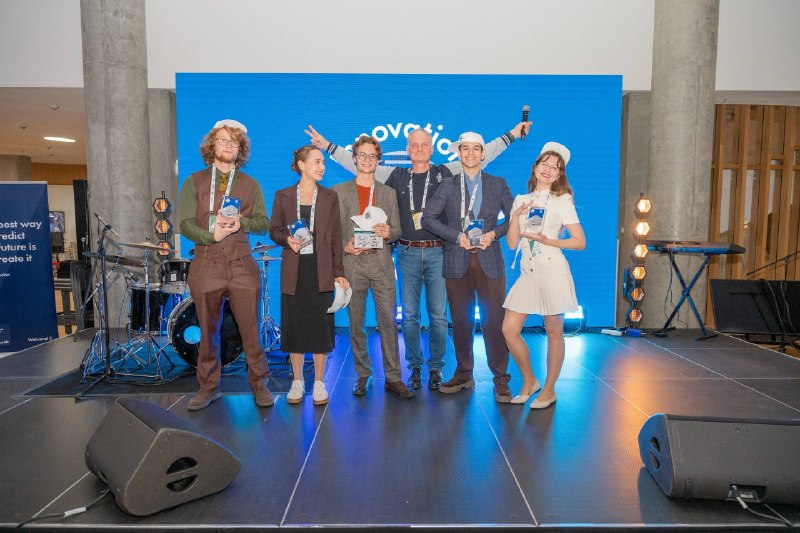
⚡️ We are starting our review of the winners of the Innovation Workshop 2026! Today we introduce you to the team that created a microfluidic model of the human lymph node — a platform where immune cells can interact in a three-dimensional environment and form a more physiologically relevant immune response. From idea to prototype “This summer, Polina Guseva [team member, first-year master’s student in the Life Sciences program] completed a research internship in China, where she was introduced to the use of microfluidic technologies for working with cell cultures,” the team says. “This experience inspired her to explore the organ-on-a-chip concept in more detail. One of the complex challenges in immunology remains reproducing the physiological activation of B lymphocytes and the subsequent humoral immune response. That is how the idea to create a microfluidic model of the lymph node was born.” How it works The project turned out to be truly interdisciplinary: mathematical modeling of fluid flows, CAD and CAM design, microfluidics, laser processing, silicone chip casting with vacuuming, electronics development and soldering, microcontroller programming, and peristaltic pump assembly. And that’s not all — working with cell cultures, microscopy, and flow cytometry to assess cell viability. “Perhaps it is precisely the combination of engineering and experimental immunology that became one of the most interesting features of the project.” Engineering without sleep “The hardest part was keeping up with the pace of the Innovation Workshop. We had to simultaneously develop the device, conduct experiments, communicate with experts, and prepare presentations. Sometimes it felt like there weren’t enough hours in the day. But it was this pace that taught us to quickly prioritize and make decisions under time constraints.” There were especially many doubts at the beginning: where to manufacture the chip, what material to use, what equipment to choose. “We started searching for information, reaching out to specialists, and literally piecing together the necessary knowledge bit by bit. It helped a lot that there were many people around willing to consult and share their experience.” What the team is proud of “The attitude of each person toward the project. Everyone was involved and ready to invest as much time and effort as needed. Every evening we gathered, discussed what we had managed to accomplish, what problems had arisen, and what tasks to close the next day. Everyone had their own area of responsibility, but no one approached the project with the attitude of ‘that’s not my task’.” What’s next There are two directions planned: engineering and biological. On the engineering side — increasing the autonomous operation time of the base station, improving the perfusion system, and moving from one chamber to an eight-chip station. The main next stage is biological validation: seeding the chip with primary human immune cells and demonstrating how follicle-like structures form. “After confirming biological functionality and publishing the results, the next big step will be commercialization and reaching the first users.” We wish the team the best of luck and will continue to follow their progress! ✨ Skoltech is part of the VEB.RF group.