
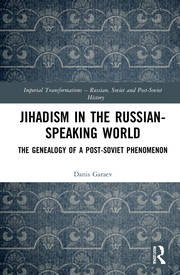
Jihadism in the Russian-Speaking World. The Genealogy of a Post-Soviet Phenomenon 🆕 XXXIII коллоквиум «Читая ислам, понимая мусульман» состоится в среду 11 ноября в 18:30, пройдет только онлайн и будет посвящен книге Даниса Гараева «Jihadism in the Russian-Speaking World. The Genealogy of a Post-Soviet Phenomenon» [Routledge, 2023]. 📥 В год 25-летия терактов 11 сентября 2001 года разговоры о «глобальном исламизме» и «исламском терроризме» как единой, универсальной и почти не зависящей от исторического контекста угрозе вновь набирают обороты. Однако у Даниса Гараева для сторонников этой объяснительной модели плохие новости. В своей книге он на богатейшем эмпирическом материале убедительно показывает, что кажущиеся глобальными идеологии достаточно укоренены в локальных контекстах. И русскоязычный джихадизм оказывается не столько импортом ближневосточного радикализма, сколько продуктом постсоветского интеллектуального пространства с теорией пассионарности Льва Гумилёва и образами манкурта из произведений Чингиза Айтматова. На встрече обсудим, почему такой подход полезен не только в изучении джихадистского дискурса, и почему иногда не стоит увлекаться интертекстуальностью. 🔉Дискуссанты: Данис Гараев, Егор Крыков и Софья Рагозина. 🖱 Garaev, Danis. Jihadism in the Russian-Speaking World: The Genealogy of a Post-Soviet Phenomenon. Routledge, 2023. 224 p. 🖱 Description: This book contends that the discourses of jihadism in Russia's North Caucasus, and their offshoots in other parts of the Russian Federation, are not just reflections of jihadi ideologies that came from abroad, rather that post-Soviet jihadism is a phenomenon best understood when placed in the broader cultural environment in which it emerged, an environment which comprises the North Caucasus, the whole of Russia, and beyond. It examines how post-Soviet jihadism is also part of global processes, in this case, global jihadism, explores how post-Soviet jihadism bears the imprint of the preceding Soviet context especially in terms of symbols, discursive tools, interpretational frameworks, and dissemination strategies, and discusses how, ironically, Russian-speaking jihadism is an expansionist idea for uniting all Russian regions on a supra-ethnic principle, but an idea that was not born in Moscow or St. Petersburg. Overall, the book demonstrates that Russian-speaking jihadism is a completely new ideology, which nevertheless has its origins in the intellectual and cultural heritage of the Soviet era and in the broader trends of post-Soviet society and culture. ✅ Для подключения к мероприятию необходимо пройти по ссылке (код встречи: a9alnw, пароль: ah9nr2ho). Аудио- и видеозаписи встречи вестись не будет. ✈️ Если вы знаете, кому может быть интересно это мероприятие (студенты, аспиранты), пожалуйста, поделитесь с ними ссылкой.