
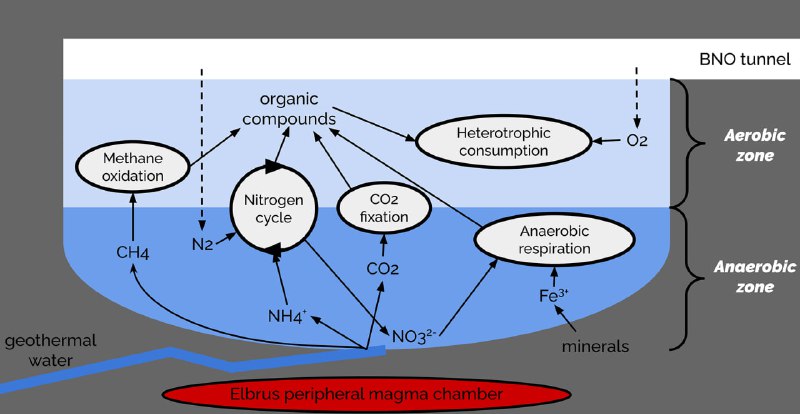
🔬 В Баксанском подземном источнике обнаружили уникальную переходную экосистему Учёные ЛЯП ОИЯИ совместно с коллегами из ИЯИ РАН изучили микробное сообщество источника в Баксанской нейтринной обсерватории ИЯИ РАН и впервые подробно описали переходную зону между глубокой подземной и поверхностной биосферами. В ходе работ исследователи обнаружили 19 геномов, принадлежащих к различным группам бактерий. «Полученные данные описывают новый тип биологического сообщества и предлагают модель для изучения микробной колонизации в переходных зонах, где сталкиваются обитатели двух разных экосистем», – отметила начальник сектора молекулярной генетики клетки ЛЯП ОИЯИ Елена Кравченко. Также учёные идентифицировали шесть новых родов бактерий. Им были присвоены кандидатные названия, отражающие географию поиска и вклад в работу обоих институтов: 💙 Candidatus Neutrinobacter 💙 Candidatus Jinrextremum 💙 Candidatus Inralta 💙 Candidatus Jinrbaksania 💙 Candidatus Neutrinellum 💙 Candidatus Inrsubterrania ➡️ Подробнее 🟦🟦🟦🟦 🔬 Unique transitional ecosystem discovered in Baksan underground spring DLNP JINR scientists, together with colleagues from the Institute for Nuclear Research of the Russian Academy of Sciences, studied the microbial consortium of a spring at the INR RAS Baksan Neutrino Observatory and, for the first time, described in detail the transition zone between the deep underground and surface biospheres. During the study, the researchers discovered 19 genomes from different groups of bacteria. "The data obtained describes a new type of biological consortium and offer a model for studying microbial colonisation in transition zones, where inhabitants of two different ecosystems meet", Head of the DLNP JINR Molecular Cell Genetics Sector Elena Kravchenko said. Moreover, scientists identified six new genera of bacteria. They were given candidatus names reflecting the geography of the search and the contribution to the work of both institutes: 💙 Candidatus Neutrinobacter 💙 Candidatus Jinrextremum 💙 Candidatus Inralta 💙 Candidatus Jinrbaksania 💙 Candidatus Neutrinellum 💙 Candidatus Inrsubterrania ➡️ More details #jinr_science