
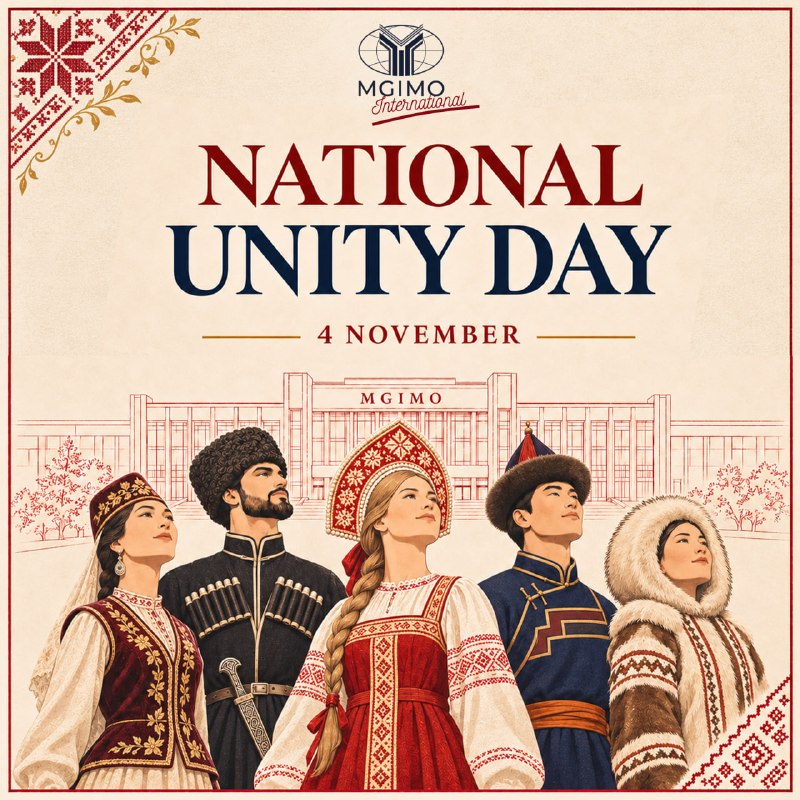
🇷🇺 Happy National Unity Day! Getting to know Russia—its history, culture and traditions—begins even before you arrive to study here. National holidays offer insight into the historical events that continue to shape society and the ways in which a country’s understanding of itself is passed down through generations. On 4 November, Russia celebrates National Unity Day—a celebration of the solidarity of its diverse peoples, their devotion to their country and the spiritual values they share amid a rich variety of cultures and traditions. Historical background In the early 17th century, Russia experienced the Time of Troubles—a prolonged crisis marked by struggles for the throne, internal strife and foreign intervention. Central authority had weakened, and a Polish-Lithuanian garrison occupied the Moscow Kremlin. In Nizhny Novgorod, Kuzma Minin, elected head of the local community, appealed for funds to raise a volunteer army under the military command of Prince Dmitry Pozharsky. People from different social classes, regions and ethnic backgrounds joined its ranks. The liberation of Moscow in the autumn of 1612 and the election of Mikhail Romanov as tsar in 1613 by the Zemsky Sobor—an assembly representing different social groups and regions—were decisive steps towards overcoming the crisis and restoring state authority. A monument to Minin and Pozharsky by the sculptor Ivan Martos stands in Red Square. Unveiled in 1818 and funded by donations from across the country, it was Moscow’s first sculptural monument. Its inscription reads: “To Citizen Minin and Prince Pozharsky, from a grateful Russia.” These words honour the leaders of the volunteer army who united their compatriots in defence of their country. The pairing of “Citizen” with a princely title underscores the contribution of people of different social backgrounds to a common cause. This tradition of solidarity—of overcoming divisions and taking shared responsibility for the country’s future—lies at the heart of National Unity Day. 2026 has been declared the Year of Unity of the Peoples of Russia, dedicated to strengthening harmony among more than 190 ethnic groups that call Russia home. Over the centuries, their languages, cultures and traditions have developed through close interaction, retaining their distinctive character while forming part of a shared historical heritage. This year, with the support of the Federal Agency for Ethnic Affairs (FADN Russia), the University launched the Unity of the Peoples of Russia Student Project Office. Its primary mission is to bring together students from all 89 regions of the Russian Federation, foster a space for intercultural dialogue, strengthen bonds of friendship among representatives of Russia’s diverse peoples. Through the Telegram channel “MGIMO for Unity”, project participants share insights into the rich history, cultural heritage, and distinctive traditions of the peoples of Russia. 🌐 MGIMO brings together students from across Russia and 96 countries worldwide, with 56 languages taught at the university. Learning about other cultures and traditions is an integral part of life here. Studying together and collaborating on research and creative projects allow students to deepen their understanding of one another’s cultures and discover shared interests despite differences in background, outlook and experience. In varietate concordia—“Unity in Diversity”—is the motto of MGIMO’s Council of Regional Student Associations. Understanding different perspectives and finding common ground while respecting differences are essential skills for future international affairs professionals. These skills develop throughout their university years, through discussion, collaboration and friendships that often endure across borders for decades. Happy National Unity Day to all our students, applicants, colleagues and friends! We hope you enjoy discovering the richness and diversity of Russia’s history, culture and traditions! ❤ 🌐 MGIMO International (ENG) | МГИМО для иностранцев (RUS)