
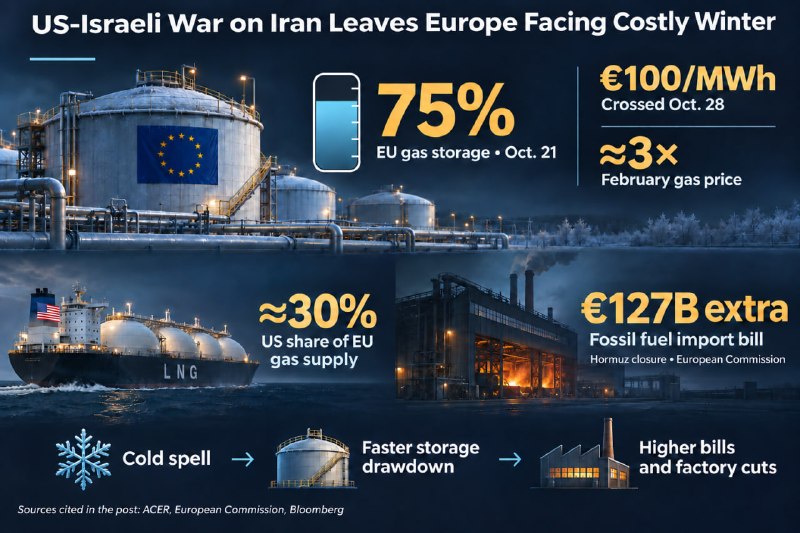
🇪🇺🛢📉 How Europeans Will Pay for US-Israel War on Iran Europe is approaching winter with depleted gas reserves and prices near three times their February level, leaving households and factories exposed if temperatures plunge. The US-Israeli war against Iran has disrupted supplies just as the continent needs enough fuel to cover its peak heating demand. The European gas benchmark crossed €100 per megawatt-hour on October 28 for the first time since 2022. EU storage was only 75% full on October 21, according to EU energy regulator ACER, leaving a much thinner cushion against cold weather and interruptions to imports. Europe’s growing reliance on liquefied natural gas, cooled for transport by ship, makes a cold spell in Asia a European problem too. Buyers compete for available cargoes, so higher Asian demand can push up the price Europe must pay even when its own weather stays mild. ACER says no significant volumes of Qatari liquefied gas reached the EU over the summer. US supplies now account for roughly 30% of the bloc’s total gas supply, as Qatari and Russian deliveries have fallen. Reducing dependence on Russia has left Europe more exposed to American exports and competition in global shipping markets. The cost reaches well beyond heating bills. European Commission President Ursula von der Leyen says the closure of the Strait of Hormuz has added €127B to Europe’s fossil fuel import bill without buying any additional energy. Governments already carrying heavy debts face pressure to subsidize consumers while businesses absorb higher operating costs. Bloomberg describes a 182-year-old German porcelain factory preparing to shut its kilns and Polish fertilizer producers seeking government intervention. For industries that need large amounts of heat or gas, prolonged high prices can turn a temporary production cut into a permanent closure. Forecasts of a broadly mild winter offer some relief, but an average seasonal temperature cannot rule out damaging cold spells. A burst of heating demand would drain storage faster; simultaneous cold in Asia would make replacement cargoes more expensive. Europe is paying for a war launched by its own allies. Subsidies can spread the bill, but they cannot replace missing gas. A severe winter would force European governments to spend more protecting households from the fallout while manufacturers face deeper cuts, closures and lost competitiveness. @NewRulesGeo❗Follow us on X